


A unified CRM platform is a single system that brings sales, marketing, service, and operational data together into one centralized record, replacing separate tools with one real-time view of the customer. Consolidation solved where the data lives. It did not settle what acts on it. In 2026, the question a unified platform has to answer is whether it produces a Data Foundation that an AI layer can act on, or one very tidy place to store what has already happened.
The consolidation worked. Eighteen months, a seven-figure programme, four systems collapsed into one. The migration landed, the legacy licences were cancelled, and every metric the project was scored on came in green: one record, one source of truth, one place for marketing, sales, and service to look. That programme was very likely the defining initiative of somebody's tenure, and it deserved to be.
Then the AI initiative arrives. The first questions are which fields are governed, where the customer definition is authoritative, and what the pipeline of prepared data looks like for the use case in front of you. There is one platform. There is one record. And there is no answer. This is the part worth being exact about, because it is where most accounts of this moment get it wrong: nothing about the consolidation was a mistake. It was scored against the question everyone was asking at the time, and it answered that question correctly. The requirement moved. What is missing is the layer that nobody specifies at implementation time, the activation layer that turns a governed record into autonomous execution, and produces Revenue Intelligence, the real-time measurement that shows whether that execution is producing revenue rather than activity.
What a unified CRM platform is
A unified CRM platform is a single system that integrates multiple customer engagement channels, databases, and analytics tools to provide a seamless, real-time view of customer interactions. Unlike standalone CRM tools, a unified platform brings sales, marketing, customer service, and adjacent operational processes into one centralized hub. That definition was accurate when this page was first published, and it remains accurate now; the rest of this article does not dispute it. It observes something the definition itself leaves open: a view is not an action.
The category exists because disconnected systems produce three specific, well-documented problems, and all three are still real:
- Data silos. Customer data sits trapped in isolated systems, and the same customer looks different depending on which one you open.
- Misalignment between departments. Marketing and sales hold different pictures of the same account, and each is internally consistent.
- Lack of automation. Manual data entry and workflow gaps fill the space between systems that were never introduced to each other.
Consolidation addresses all three at the level they were diagnosed. One platform means one place the data lives, one record for departments to share, and one automation surface instead of a mesh of exports. That was the correct answer to the question being asked.
Why consolidation was the right answer, and still is
It's worth being clear that this was not a fashionable decision; it was the right decision, and the market data says so. When the consolidation case was being made, Gartner's analysis of the 2022 CRM market recorded 14.0% growth to $96.3 billion, and the fastest-growing part of that market was the cross-CRM segment, at 19.5%. The money was moving toward systems that spanned functions rather than serving one. Buyers weren't following a trend. They were solving fragmentation, and the market was pricing the solution.
Adoption tells the same story from a different angle. Gartner's CRM market forecast projects that by 2027, 89% of large enterprises in North America will have adopted some form of CRM software, up from 80% in 2023. That number is the honest framing of where the reader stands: having a CRM is approaching universal, which is precisely the condition under which having one stops distinguishing you from anyone. The same forecast puts AI-influenced software at 8.5% of total CRM spending by 2027, a thin slice, which is why the substrate question is live right now rather than settled.
So the record stands. Consolidation delivered what it promised: the data lives in one place, departments share a record, and automation has a surface to run on. Those benefits are real, they persist, and everything in the rest of this article assumes them. Consolidation is not a detour from what comes next. It is the prerequisite for it.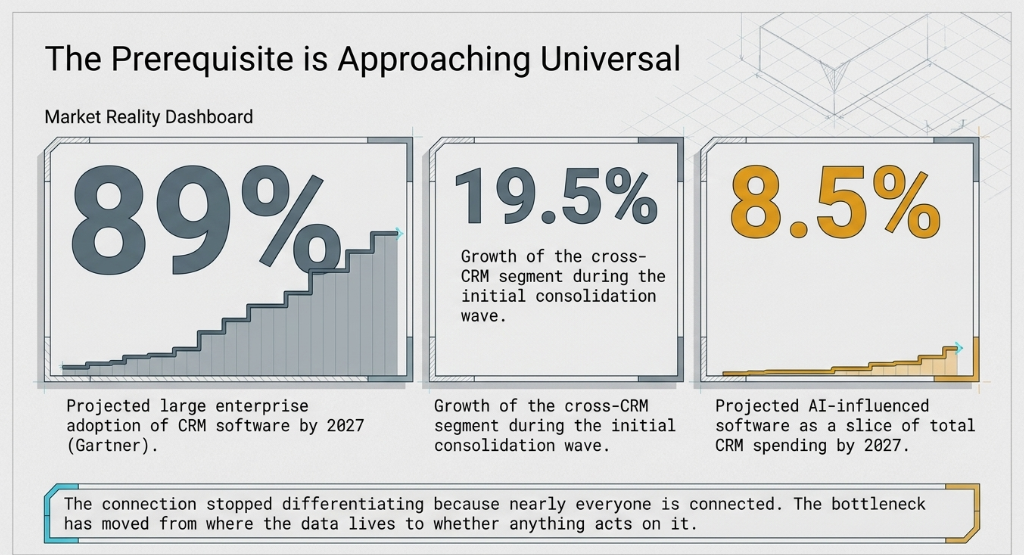
Suite vs best-of-breed: the argument as it actually stands in 2026
This is the debate the category has always run on, and it deserves an honest answer rather than a vendor's. The most useful outside position comes from Gartner's guidance on composable enterprise strategy, which is candid about the trade: standardizing on a suite may require compromises, because "no single ERP suite vendor has best-in-class capabilities in all areas." Anyone who has run a consolidation already knows this. They made the trade deliberately, accepting a merely good module in one function to get coherence across all of them, which was the correct call when coherence was the scarce thing.
Two things have shifted since. Gartner also notes that suite-vendor products are maturing quickly and approaching parity with best-of-breed alternatives, which narrows the cost of the trade. And Gartner's own recommendation is not "suite or best-of-breed" at all; it advocates a composable approach, an adaptive strategy that lets an enterprise keep pace with fast business change, even when consolidating. Composability sits on top of consolidation. It is not an alternative to it.
That reframes the question productively. The interesting decision in 2026 is not which suite to stand on or whether to have stood on one. It's what you compose above the consolidated core, and whether the core produces something, the composed layer can act on. Consolidate the record. Compose what acts on it.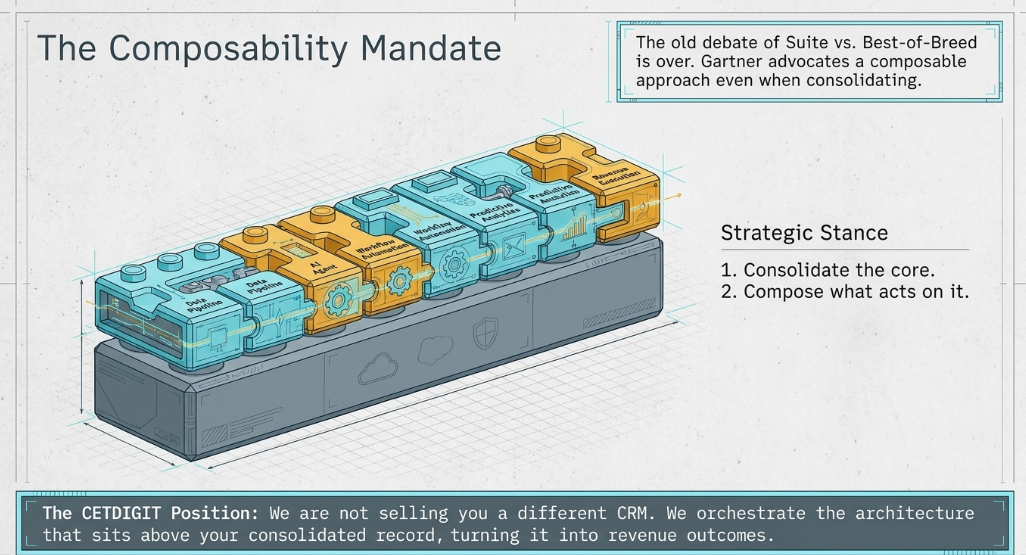
How to evaluate a unified CRM platform
Five evaluation considerations have held up well, and they remain the right starting point for anyone assessing a platform today:
- Scalability and flexibility. Whether the platform grows with the business without a re-implementation at every threshold.
- Integration with existing tools. Whether it connects cleanly to email marketing, social, help desk, and financial systems, or requires a translation layer for each.
- User-friendly interface. Adoption collapses when people struggle, and a platform nobody uses produces no record worth having.
- Customization and automation. Whether the platform bends to how you actually sell, and whether its workflows remove tasks or relocate them.
- Robust security. Encryption, role-based access, and the governance posture a regulated business needs to defend.
Those five are necessary and they are no longer sufficient, because every one of them was specified when the goal was a working system of record. Each now carries a second question underneath it, which the decision table below sets out row by row. The short version: a platform can pass all five and still hand an AI initiative a dataset it can't act on.
A note on vendors, since the category is full of them. Salesforce, HubSpot, Microsoft Dynamics, Zoho, and Pipedrive are the platforms most enterprises actually shortlist, and they differ in real ways, enterprise depth and customization, ecosystem gravity, price-to-capability, and how much configuration each demands before it fits. A ranked list would be dishonest, because the ranking depends entirely on the estate you're standing in and on trades only you can weigh. What is worth saying plainly is that the choice among them matters less in 2026 than what you build on top of whichever one you choose.
Who does this affect in 2026
If you run RevOps or carry a revenue number at an enterprise or upper-mid-market company, you probably finished this project already. The platform is live, adoption is real, the record is genuinely unified, and the board has now approved an AI initiative that the unified record turns out not to be ready for. You are not an outlier. Gartner's 89%-by-2027 figure means nearly every peer is standing where you are, with a consolidated CRM and an AI mandate, discovering that those two facts don't connect the way everyone assumed they would.
What changed by 2026
What held then still holds: consolidating the customer record was the correct answer to fragmentation, and one governed place for the data beats four ungoverned ones. What changed is that the connection stopped differentiating, because nearly everyone is connected now, and plenty are consolidated. The bottleneck moved from where the data lives to whether anything acts on it.
The clearest evidence comes from two analyst houses that arrived at the same diagnosis independently. Gartner's account of the future of enterprise applications names the trends enterprise application leaders must address: the adaptive experience, autonomous orchestration, embedded intelligence, connected data, and composable architecture. Note that connected data and autonomous orchestration appear as two separate items. Gartner is not treating one as a consequence of the other. It also describes a new class of software designed to "automate and orchestrate end-to-end business processes" while connecting multiple systems of record, which is a description of a layer above the platform, not a feature inside it.
Forrester's 2026 enterprise software predictions, published in November 2025, reach the same place from a different direction. Forrester describes enterprise software shifting from a user-centric design philosophy to a worker- and process-centric one: the point is no longer optimizing individual tasks but digitizing entire processes and "accommodating a digital workforce of AI agents," with role-based agents that orchestrate and complete work across multiple systems. And Forrester names the remaining bottleneck explicitly: business process standardization and data fragmentation, a data problem, not an AI problem.
Two houses. Same gap. Neither says consolidation delivers orchestration.
There's a third data point worth sitting with, because it aims directly at what a unified platform is for. Gartner's July 2026 analysis of agentic AI puts up to $234 billion of enterprise application spending, roughly 20% of enterprise application SaaS spending by 2030, at risk from agentic arbitrage, which occurs when AI agents complete tasks across multiple systems and reduce the need for people to work inside each interface. "Agentic AI changes the economics of software," in the words of Gartner's George Brocklehurst. Buyers, Gartner argues, will stop buying more tools and dashboards and start buying outcomes, and outcomes require systems that retain institutional memory and customer context over time. Sit with what that means for this category: a unified platform's core value proposition is a unified interface over a unified record. Gartner's thesis is that the interface is exactly what agentic AI arbitrages away.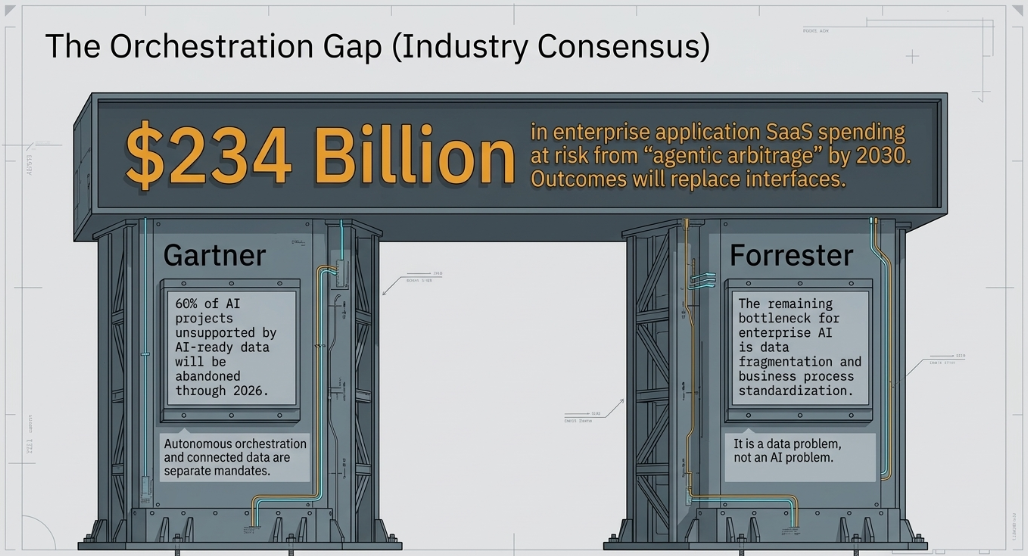
Even the market's growth story has changed its explanation. Gartner's analysis of the 2024 CRM sales software market records 12.2% growth to $25.7 billion, down from 13.9% in 2023, and attributes the growth to functional expansion, adoption, and price rises, underpinned by the ROI of improving seller efficiency with AI-powered tools. The consolidation wave is maturing. What's driving spend now is what acts on the data, not where it sits.
The Silo Tax at platform scale
The Silo Tax is the cost an organization pays when its systems hold data that moves but does not mean one thing, data that is connected, or consolidated, and still not governed, aligned, or ready for anything to act on.
Here is the part that surprises people, and it should be said carefully because it sounds like a criticism and isn't: consolidation does not eliminate the silo. It relocates it. The old diagnosis was that data sat trapped in isolated systems, and the cure was to put it in one system. That cure worked; the data is no longer isolated. But the standard AI applies is not how many platforms this data is in. Gartner's research on AI-ready data defines AI-ready as data aligned to specific use cases, governed at the asset level, supported by prepared pipelines, described by active rather than passive metadata, and continuously assured. Nothing in that list is satisfied by co-location. One platform can be one very tidy silo.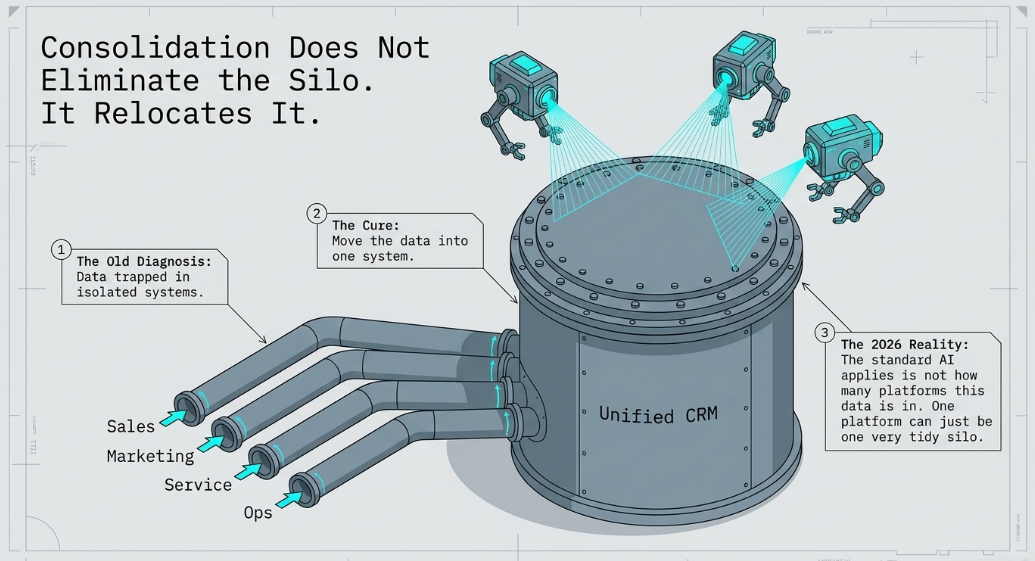
Nobody could have known where the silo would land until AI arrived to ask. Gartner measures the consequence: the firm predicts "organizations will abandon 60% of AI projects unsupported by AI-ready data" through 2026, and reports that 63% of organizations either lack or are unsure whether they have the right data management practices for AI. Read Gartner's own description of the failing estate, data collected in silos across repositories, systems, and platforms, managed by practices too slow, too structured, and too rigid for AI teams, and notice that "one platform" is not an exemption from it. Forrester, independently, calls the bottleneck data fragmentation and locates it in the data layer rather than the AI layer.
You are paying the Silo Tax at platform scale if:
- The platform holds one customer record, and three teams still reconcile revenue numbers before a board meeting.
- An AI initiative's first question, which fields are governed, and by whom, has no owner.
- Every new AI use case opens with a data-preparation project nobody budgeted.
- Reporting is clean, current, and describes what already happened, and nothing in the system acts on what it says.
The root cause is scope, not execution. The consolidation was scoped to unify the record, and it did. Governance at the asset level, use-case alignment, and active metadata were not in the specification, because in 2023, nothing was going to read the record autonomously.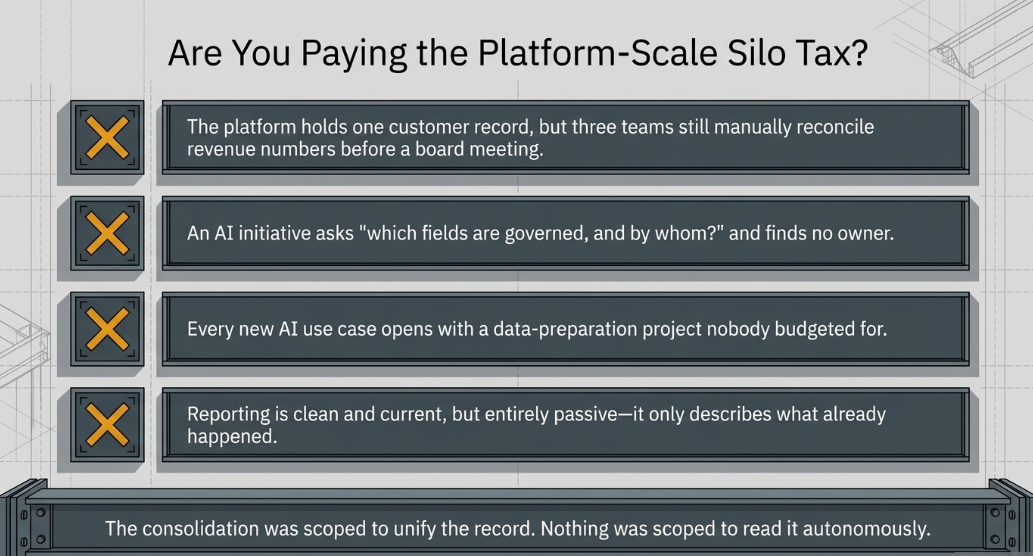
The Data Foundation: what a unified platform has to produce now
A Data Foundation is the substrate beneath AI: data aligned to the use cases it serves, governed at the asset level, delivered through prepared pipelines, described by active metadata, and continuously assured. Those are Gartner's five steps to AI-ready data, which is what makes the Data Foundation testable rather than aspirational. You can score your consolidated platform against them this quarter and get an honest answer.
That is the 2026 selection question, and it is a different question from the one the category was built to answer. Not "is my CRM unified", yours is, and that was the right thing to do. The question is whether the unified record is something an AI layer can act on, or one very well-organized account of what already happened. Those are different artifacts, and the gap between them is what an AI-ready data foundation requires: governance, resolution, and use-case alignment applied to the data itself, sitting above the platform that stores it.
Evaluating a unified platform against a 2026 requirement: the decision table
|
Criterion |
What it meant when the connection was the question |
What does it have to mean now |
|
Scalability and flexibility |
Does the platform grow with our volume and headcount? |
Does it scale governance with the data, or only storage? |
|
Integration with existing tools |
Does everything connect to the central record? |
Does connected data arrive use-case aligned, or merely arrive? |
|
User-friendly interface |
Can our people work in it without friction? |
Can an agent act on it without a person interpreting it first? |
|
Customization and automation |
Can workflows match how we sell? |
Does the workflow complete the work, or shorten a human's task? |
|
Security and governance |
Is access controlled and data encrypted? |
Is each data asset governed, with metadata active rather than passive? |
No row implies the consolidation was a mistake. Each row shows a criterion that was correctly specified for a system of record, now carrying a second requirement that nobody wrote into the original evaluation because nothing was going to read the record autonomously.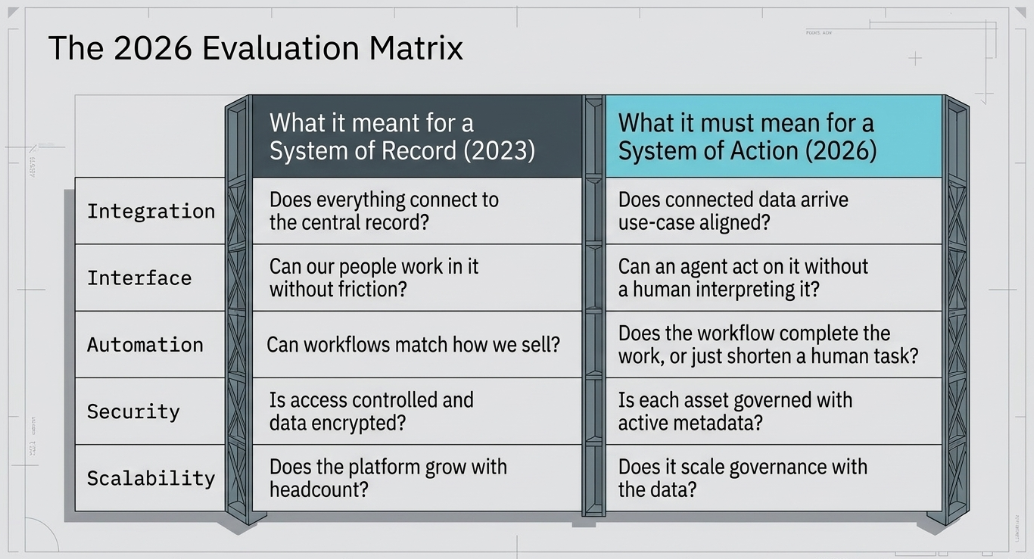
The CETDIGIT perspective
CETDIGIT's position is that consolidation and orchestration are two different problems, and that the industry spent a decade solving the first while assuming it would deliver the second. It doesn't, and the analysts now say so in their own vocabulary. A unified platform is a system of record: it stores, syncs, and reports. A System of Action senses a signal and executes revenue work without waiting for a person to move the deal forward. Between them sits the activation layer, the thing nobody specifies at implementation time, because at implementation time, no one was going to read the data but a human.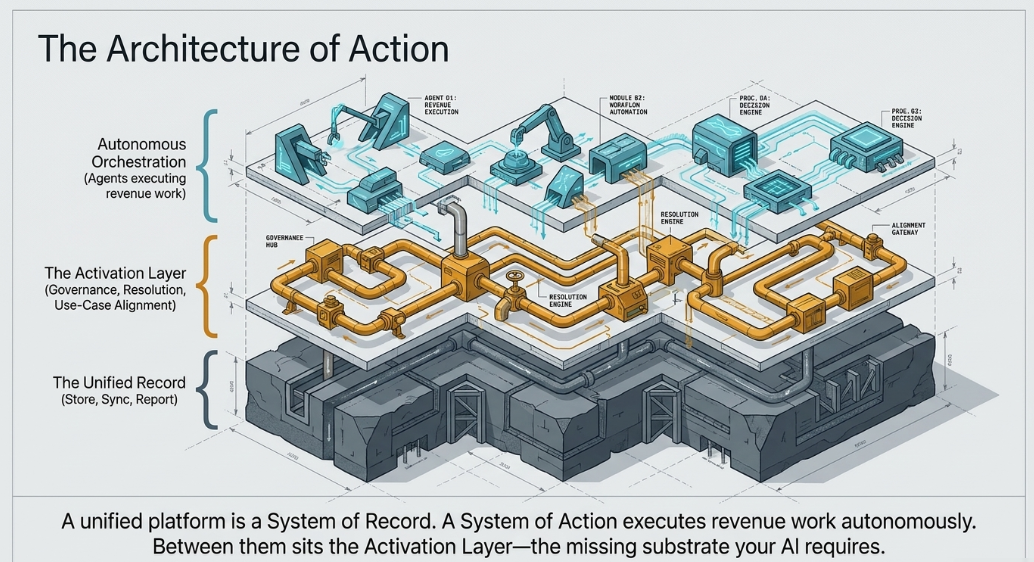
This is also why we model the estate as a Revenue Graph rather than a linear funnel. Buying decisions in 2026 form across channels, systems, and stakeholders in ways a pipeline report flattens, and the graph describes how revenue actually moves, which is what an agent needs to act on and what a unified view, however tidy, doesn't supply on its own. Get the substrate right and the orchestration question becomes tractable: that's where connecting the unified record to revenue outcomes does its work. We orchestrate that architecture. We're not a partner of any platform in it, and we're not selling you a different one.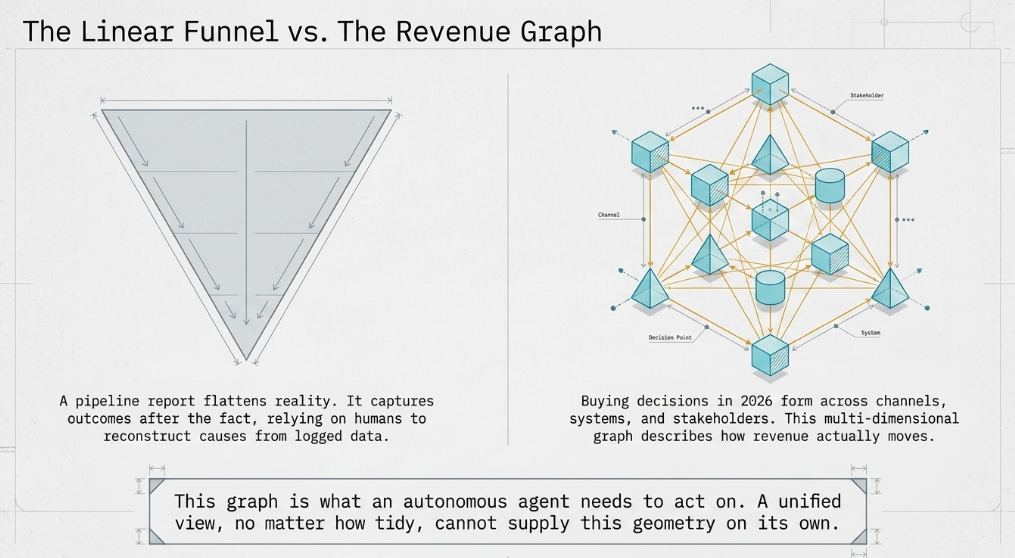
Recommended path
If your consolidation succeeded and your AI initiative is stalled on data questions the platform can't answer, those two facts are related, and neither is a failure. The sequence that works starts beneath the AI rather than beside it: score the unified record against the five AI-ready criteria and find out which are actually satisfied. CETDIGIT's Data and AI Foundation engagement builds what the agents will read, asset-level governance, resolved definitions, and pipelines aligned to the revenue use cases you intend to run, on top of the platform you already have. It sits within CETDIGIT's AI services framework alongside the orchestration and revenue-architecture work it enables, and how a stack unification engagement actually runs is documented if you want the methodology before a conversation.
Frequently asked questions
What is a unified CRM platform?
A unified CRM platform is a single system that integrates multiple customer engagement channels, databases, and analytics tools to provide a real-time view of customer interactions, bringing sales, marketing, service, and operational processes into one centralized hub rather than separate tools. It addresses three specific problems: data trapped in isolated systems, departments holding different pictures of the same customer, and manual work filling the gaps between disconnected tools. Consolidation solves where the data lives.
What are the best unified CRM platforms?
The shortlist most enterprises actually consider is Salesforce, HubSpot, Microsoft Dynamics, Zoho, and Pipedrive, and they differ in enterprise depth, ecosystem gravity, price-to-capability, and configuration burden. A ranking would be dishonest; the right answer depends on your estate and on trades only you can weigh. Gartner's own guidance is candid that no single suite vendor is best-in-class in every area, and that the productive strategy is composable: consolidate the core, then compose what acts on it.
Is a single platform better than best-of-breed?
Gartner's position is more useful than either side of the usual debate: standardizing on a suite may require compromises because no single vendor leads in all areas, but suite products are maturing toward parity with best-of-breed, and Gartner advocates a composable approach even when consolidating. Composability sits on top of consolidation rather than replacing it. The 2026 question isn't suite versus best-of-breed; it's what you compose above the consolidated core, and whether the core produces something that the layer can act on.
What is CRM platform integration?
CRM platform integration is the work of connecting the CRM to the systems around it, email marketing, service desk, financial systems, and data warehouses, so that customer data flows between them rather than being re-keyed. A unified platform reduces how much of that work is needed by bringing functions into one system. Integration guarantees that data moves. It does not guarantee that data is governed, use-case aligned, or ready for anything to act on autonomously, which is a separate requirement.
Does consolidating onto one CRM eliminate data silos?
It eliminates the silo as originally diagnosed, data trapped in isolated systems, and that was worth doing. What it doesn't do is satisfy the standard AI applies. Gartner defines AI-ready data as aligned to specific use cases, governed at the asset level, supported by prepared pipelines, described by active metadata, and continuously assured. None of that is delivered by co-location, which is why a consolidated platform can still be one very tidy silo. Gartner predicts organizations will abandon 60% of AI projects unsupported by AI-ready data through 2026.
What makes CRM data AI-ready?
Gartner's five steps define it: align data to the AI use cases it will serve, identify governance requirements for AI specifically, evolve metadata from passive to active, prepare the data pipelines, and assure and enhance the data continuously. Gartner reports 63% of organizations either lack or are unsure of the right data management practices for AI. The distinction that matters: integrated data has moved somewhere, and AI-ready data can be acted on. Most consolidated CRMs deliver the first.
Why doesn't our unified CRM answer what's driving revenue?
Because a unified record answers where data lives, and attribution is a question about what acts on it. If revenue work is triggered by people reading reports, the system captures outcomes after the fact and reconstructs causes from what got logged. Forrester names data fragmentation as the remaining bottleneck for enterprise AI and classifies it as a data problem rather than an AI problem. The gap is the activation layer, governance, use-case alignment, and orchestration sitting above the platform, not inside it.
Stack Unification Audit
Diagnose where your AI investment is leaking, connect the stack, then activate AI. You've done the connecting. Book a 60-minute Stack Unification Audit, and we'll score your consolidated record against what an AI layer actually needs from it, and show you which gap to close first.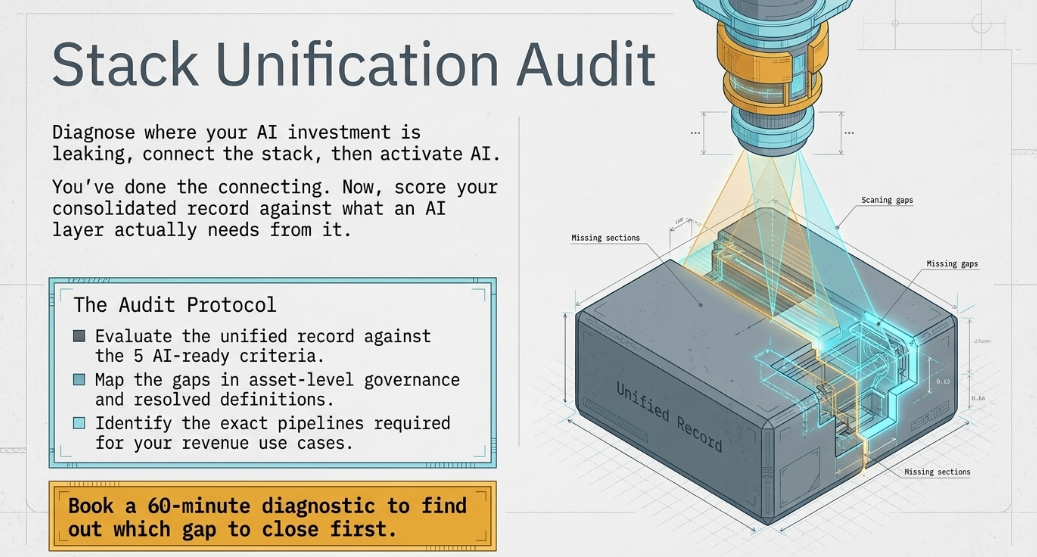


Leave a Comment